Arts-Informed Pedagogy and the Future of Archival Instruction
In Brief
Despite growing scholarship on archival instruction, the field has devoted little attention to the pedagogical expertise cultivated through arts-informed educational practice. This article uses collaborative autoethnography to examine how such expertise shaped archival instruction across two youth-facing initiatives developed with the Community-Driven Archives (CDA) Initiative and Distinctive Collections at Arizona State University. Integrating arts-based pedagogy, we argue that artistic practice is not a set of engagement techniques but a form of pedagogical expertise constituted by archival encounters. We position practitioner experience as a legitimate site of theory-building and offer an account of how such expertise can be practiced from insider and outsider positions with implications for what counts as expertise.This reframing shifts archival instruction beyond information literacy toward relational, community-centered learning that positions young people as stewards of community memory rather than passive users of records.
Imagination is one of the spoils of colonization, which in many ways is claiming who gets to imagine the future for a given geography. Losing our imagination is a symptom of trauma.
Imagination is not incidental to archival practice; it is one of its conditions. For communities whose record has been historically erased, engaging the archive means not only confronting those absences but imagining oneself as someone whose life and history are worth preserving. When young people cannot picture themselves as future stewards of the record, that absence quietly shapes what archival practice becomes. Arts-informed pedagogy, as we understand and practice it, offers one way of refusing that outcome.
Scholarship on critical pedagogy in archival literature has grown considerably, but it has remained largely disconnected from scholarship on pedagogy generated through artistic practice. When arts-based approaches appear in the archival instruction literature, they are typically framed as techniques. We argue instead that artistic training constitutes a form of pedagogical expertise: a way of understanding how learning unfolds, how relationships of trust and belonging are cultivated, and how meaning emerges through embodied, affective, and collaborative processes. Rather than sitting alongside archival pedagogy as a supplemental methodology, this expertise expands the possibilities of archival pedagogy. We write primarily for archival professionals engaged in instruction and outreach. We are especially interested in those whose work focuses on youth engagement in community settings in partnership with higher education institutions.
Archival instruction has matured as a field over the past two decades, but largely around information literacy and assessable learning outcomes. This leaves the affective, relational, and embodied dimensions of archival learning that become most visible in work with youth, multilingual learners, and community partners underexplored. Where scholarship attentive to those dimensions has emerged, it has largely focused on the contributors and users of archives; we turn instead to practitioners, asking what expertise makes these encounters possible. In our own work, this expertise comes from artistic training. Expertise of this kind draws on several sources, among them lived experience, community practice, and bilingual communication. What we offer others is not a position to replicate, but a way of practicing. Archivists should create the conditions for people to document their own lives and determine what is preserved, while remaining attentive to the boundaries and ethical stakes of doing this work from a position that is never entirely inside or outside the community.
Archives are never neutral; they are sites where communities are represented, distorted, or erased through decisions about whose records are kept and whose are never collected. Community-driven archival practice emerges as an intentional response to that erasure, offering a means of returning authority over the record to those it has misrepresented or left out. Socially engaged artistic practice, in turn, takes collaborative making as its method. Brought together, artistic practice, community, and the archive do together what none does alone. Artistic practice is expressive, generative work that makes memory rather than merely recording it. Community establishes the authority to decide whose memory counts. Finally, the archive adds permanence, casting what is made as a record and its makers as its keepers. Together, art, community, and the archive create a practice in which people collaboratively make the memory of their own communities and take responsibility for keeping it.
Our arts-based pedagogy is not relevant for all artistic practice. Much artistic training is solitary and technical. The pedagogical expertise we draw on comes specifically from participatory and socially engaged traditions, where the work is collaborative by design and community is its material. We say “arts-informed pedagogy” rather than “arts-based activities” to mark the distinction on which this article turns. We do not describe merely creative techniques added to archival instruction. Instead, we consider arts-informed pedagogies constituted by artistic practice as a mode for navigating identity, building community, and empowering youth. Arts-based education, associated with Elliot Eisner (2002) and Maxine Greene (1995), treats the arts as ways of knowing in their own right.
Outreach with young people and community partners is where archival authority, ethics, and memory are negotiated. The Community Driven Archives (CDA) Initiative (CDA) centers BIPOC and Queer lives, promotes life-long learning, and advocates for equal ownership of archives and shared stewardship responsibilities. Empowering these learners requires instruction that centers representation, belonging, imagination, and relationships as core pedagogical concerns. For historically marginalized youth, this work begins with recognizing where the documented record is lacking, and then with understanding that these absences reflect decisions about whose lives were deemed worth documenting. Only from there does the more generative work become possible: envisioning oneself and one’s history as valuable, and worthy of preservation. Within community-driven archival practice, this work of imagination is fundamental. If young people can neither locate nor imagine themselves as future archival stewards, the future of archival practice is already being shaped by that absence. Arts-informed pedagogy, as we understand and practice it, offers one way of refusing that inheritance.
Through collaborative autoethnography, we theorize from practice rather than treating practice as evidence for preexisting theory. Across initiatives with the CDA Escuelita program, we found ourselves returning to three interconnected understandings. Archival encounters, we came to see, always carry the possibility of being affect-laden, relational, and emergent sites of meaning-making in which learners negotiate memory, identity, ethics, and historical representation. As Schlesselman-Tarango’s (2019) autoethnography of reproductive failure makes clear, records can hold grief and, revisited, reopen it. Archival encounters are never guaranteed to be benign. By assembling and theorizing her own “Archive of Reproductive Failure,” she transitions from being merely a subject of records to actively shaping and caring for them. This shift highlights the importance of intentionally creating conditions that make archival encounters respectful, fulfilling, and generative. This is the work that arts-informed, community-centered pedagogies can do. Encounters shaped by such care, in turn, cultivate capacities for cultural stewardship, inviting learners to understand themselves not merely as users of archives but as creative agents who transmit community memory. In the next section of this article, we will describe our positionality and outline our methods, followed by a literature review. Jasmine will then reflect on her work with the Community Driven Archives (CDA) initiative Escuelita, and Caelin will describe her work with the Theatre for Youth and Community Collection, before we turn to our collaboration and conclude with implications for future research.
Positionality
Caelin
Caelin Ross (she/her) is a white, queer, chronically ill academic librarian. She holds a BA in Theatre & Drama and a MLIS, and has served as Performing Arts Librarian and Curator of the Theatre for Youth and Community Collection at Arizona State University. Currently, she is the Humanities Librarian at the University of Chicago. Her racial privilege grants institutional authority often denied to BIPOC practitioners, making her analysis necessarily incomplete.
Jasmine
Vanessa Jasmine Torrez (she/her) is a Latina archivist early in her career as an archivist with the CDA Initiative at Arizona State University Library. Her undergraduate degree is in fine arts from the California Institute of the Arts, and she has a MA in LIS from the University of Arizona. She is originally from El Paso, Texas, a predominantly Latino/a/x community that borders Juarez, Mexico. She works in a profession that is largely non-BIPOC, with only 2.34% of professional archivists identifying as Latinx, according to the A*CENSUS II: All Archivists Survey Report (2022). She has a medical condition that creates physical limitations in her work. Her existing medical condition and membership in a marginalized community guide her commitment to helping historically marginalized communities see themselves represented in the archives.
As Coia and Taylor (2013, 10) write, “Insight comes in telling our stories to one another. We do not tell the stories because we have insight… Rather, it is in the telling and the retelling to each other that meaning is made and insight is gained.” Our analysis emerged through this process of telling and retelling. Although our case studies involve different audiences, we repeatedly returned to similar questions about belonging, participation, and creativity. Neither of us occupies a single position: each of us is at once an insider and an outsider.
Methods
We use collaborative autoethnography to generate theory from lived experience, aligning with feminist (Ettorre, 2017), queer (Munoz, 2009) and decolonizing (Chawla & Atay, 2018) research traditions.
We frame this inquiry through a/r/tography, an arts and education, practice-based research methodology (Sullivan, 2004) dedicated to acts of inquiry through the arts and writing (see Irwin & de Cosson, 2004; Springgay, Irwin & Wilson Kind, 2005). Both of us are, at once, artists, researchers, and educators, which we do not experience as separate roles (Irwin & de Cosson, 2004). Within our shared frame, each of us also writes from a distinct epistemic location. For example, Jasmine’s account draws on pláticas—a Chicana feminist methodology in which knowledge is produced through reciprocal, everyday conversation and relationality and cultural intuition are treated as methods rather than obstacles (Fierros & Delgado Bernal, 2016).
Caelin’s framework for entering community-based archival work is actively anti-racist, which means it begins with sustained reflection rather than with a search for permission to participate. For white practitioners drawn to working with Latinx and BIPOC communities — often without a member of that community alongside them — a first question should be whether someone closer to the specific community is already positioned to lead, and whether one’s role might instead be to resource, support, and uplift that person’s work. One temptation this reflection guards against is treating the presence of a BIPOC or LGBTQ+ colleague as a credential that “authorizes” entry into community spaces; this instinct, however well-meaning, is itself a form of racism and homophobia, because it uses another person’s identity as a permission slip rather than confronting one’s own position. This instinct, while perhaps well-meaning, is racist and homophobic. Often the most accountable act is to step back, build a relationship slowly with no guarantee of a project at its end, or decline to be the person in the room. Whatever the path, it should never make more work for the community or organization; the labor of reflection, learning the ethics of documenting a given community, and earning trust belongs to the practitioner, not to the people with whom they hope to work. The aim should not be to find a defensible way to center oneself but to participate, when participation is genuinely wanted, in a way that does not usurp community authority.
Our goal is to theorize from practice by examining moments that challenged, complicated, or expanded prevailing assumptions about what archival learning can be. Maintaining separate authorial perspectives allows us to preserve our differences rather than flatten them into a singular narrative. In doing so, we align with feminist and interpretivist approaches that understand knowledge as situated, partial, and relational rather than objective or universal. Shared themes emerged from our dialogue rather than from a predetermined framework.
We built our approaches through workshop-based programs, community-facing events, and collaborations alongside learners and community partners. The methods we describe descend from community-driven archival practice and from the CDA’s workshops and its model of shared stewardship. Such approaches are valuable pathways for creating additional avenues for communication, relationship-building, and collective meaning-making. Across our cases, learners approached archives not only as sources of information but as occasions for storytelling, identity formation, and community connection.
In addition to grounding our work in feminist and interpretivist approaches, we invoke queer methodologists who understand queer method as a resistance to normative categories and a refusal to resolve differences into a single, authoritative account. In this vein, this article is intentionally co-authored and does not resolve into a single voice. We chose to write together because of what we recognized across that difference: our collaboration did not begin as a research design but instead began when we saw, across formations as different as bilingual arts education and theatre for young audiences, that we were taking different routes to do the same pedagogical work. Our approach is queer in both method and content, and our collaboration treats the space of difference between us as the site where insight is generated, seeking not categorical conclusions but exposure, transformation, and the productive uncertainty that comes from holding non-normative positions (Batters 2025; Sullivan 2003).
We deliberately hold two senses of queer methodologies at once. We invoke queerness methodologically in order to name a way of working across difference and against normativity, while remaining accountable to queerness in its specific, embodied sense, or the actual LGBTQ+ young people our cases center. Their absence from the record and presence in these encounters is not a metaphor for outsiderness but its concrete instance.
Literature Review
How does artistic training inform the ways educators and learners experience and make meaning with archives? What possibilities emerge when we center affective, relational, and creative practices in archival instruction, and especially with youth? In this section we discuss four bodies of scholarship together: archival instruction, affect theory, community archives, and arts-based pedagogy, drawing on each while extending it toward the youth-facing, arts-informed encounters this article examines.
Over the past two decades, archivists, special collections librarians, and academic librarians have increasingly positioned instruction as central to archival practice. Professional frameworks—the ACRL Framework for Information Literacy for Higher Education (2015), the RBMS Guidelines for Primary Source Literacy (2018; rev. 2026), and the Guidelines: Competencies for Special Collections Professionals (2008)—have articulated the knowledge, skills, and dispositions this teaching requires, emphasizing critical inquiry, contextual understanding, ethical use of sources, and the competencies that enable listeners to participate in scholarly conversations. This marks a departure from earlier models that focused on orientation, exposure, or demonstration. Robyns (2001) argued that archivists should move beyond introducing collections, instead cultivating critical thinking through engagement with primary sources, and Roussain (2020) has called on archivists to claim the role of educator explicitly, advocating constructivist, inquiry-based approaches that position learners as active participants in knowledge creation rather than passive recipients of information. However, even inquiry-based and constructivist approaches tend to stay oriented toward assessable learning outcomes. Far less attention has been paid to the dimensions of archival learning that emerge through affect, relationship-building, creative inquiry, and embodied experience, all of which become especially visible with youth, multilingual participants, and community-based settings, where learning may involve recognition, belonging, grief, and identity formation alongside historical inquiry.
Affect theory and community archives scholarship challenge the notion of archival neutrality, instead highlighting archives as spaces shaped by relationships, emotion, and power (Cifor 2016; Caswell & Cifor 2016). Affect is fundamental to how records gain meaning and is central to archival care and ethics. Community archives function as sites of identity and belonging, with participation often motivated by emotional and communal significance (Caswell, Cifor, & Ramirez 2016; Roeschley & Kim 2019). We take from this scholarship the claim that emotion is among the mechanisms through which records acquire meaning, which our cases repeatedly confirmed. However, little work explores these dynamics in instructional settings with youth. We shift the focus from contributors to practitioners, asking what expertise enables such encounters.
Arts-based, critical, and feminist pedagogies describe learning as embodied, relational, and emergent, constructed through participation and experimentation rather than mastery (Heathcote 1991; O’Neill 1995). Theatre for young audiences (TYA) treats young people as full artistic citizens entitled to serious, collaborative work (van de Water 2012). Critical pedagogy challenges hierarchies and centers participants’ capacity to make knowledge (Elmborg 2012; Cahnmann-Taylor & Souto-Manning 2010; Anzaldúa 1987; Muñoz 2009). At their core, these approaches argue that learning occurs through relationships rather than through mere transmission (Bingham & Sidorkin, 2004). Together, these literatures call for a broader account of archival literacy: one that recognizes meaning-making through creativity, embodiment, and collective inquiry, grounded in arts-informed pedagogy. However, little research examines how these dynamics unfold in youth-facing archival contexts or articulates the expertise practitioners bring. The following cases intentionally illustrate arts-informed pedagogy both in formal instruction and community partnership, drawing on Jasmine’s and Caelin’s expertise.
Jasmine’s Fieldwork
CDA Escuelita
The CDA Escuelita (“Little School”), developed by the Community-Driven Archives (CDA) Initiative at Arizona State University Library, brings archival education to BIPOC and/or LGBTQ+ K–12 students. Launched in 2022, it combats underrepresentation in archives and builds interest in archival work. As assistant archivist, I draw on my experience as an elementary and arts educator, centering community engagement and bilingual instruction with materials in Spanish and English.
As a young student, I wished that there were methods that catered to me as a bilingual learner. I remember being immersed in an English-only classroom, panicking as fingers wagged side to side to remind me that we only spoke English, but I would leave and speak mostly Spanish to my mother. By the end of my first year, my Spanish had worsened, and as I got older my own community asked, “What happened to your Spanish?” Questions of belonging arose: Do I belong in the classroom? At family gatherings? Where do I fit? Full English immersion forces the erasure of students’ accustomed language, sense of belonging, and cultural identity. I gravitated toward art, preferring to draw rather than speak to express myself in the classroom without worrying that teachers would not understand. I turned to art to express myself, eventually exhibiting work and teaching K–5 bilingual students in multiple cities. I now use arts-centered pedagogy intentionally in classrooms, treating creativity as central, not secondary. Artistic practice grounds Escuelita’s approach, enabling communication beyond spoken language.
Teaching philosophy
Escuelita aims to show students they are the future of archives. I often wonder how knowing, at a young age, that my story mattered might have empowered me. This is a question that guides my work: planting seeds that students’ stories and family histories are valid, while centering their knowledge. Recognizing language as a barrier, I developed bilingual materials and activities for Escuelita. Rather than treating bilingual education as an accommodation, the program enables students and families to engage archival concepts in familiar languages. Archive kits, zine-making, creative storytelling, oral history, and reflective writing are used as tools to position students’ homes and communities as legitimate archival spaces.
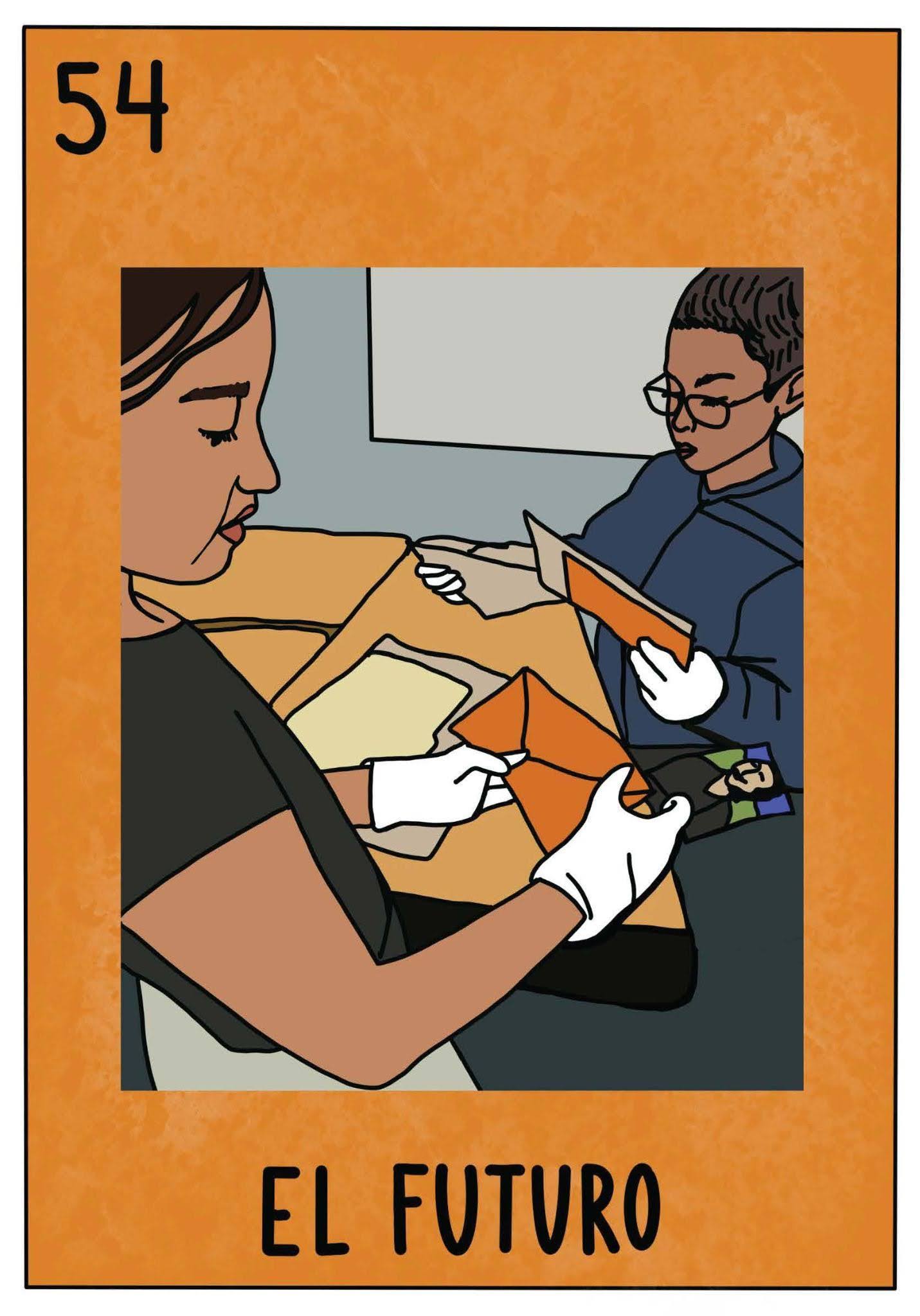
Moving between the self-guided scholarship of college students and the guided, step-by-step learning of K–12 demands a major pedagogical shift. I have taught a college class on research and primary sources from 9:00 am to noon, then headed straight to an elementary school or community center to talk about keeping memories safe using archive kits. CDA’s archive kits for youth contain acid-free folders, cotton gloves, and mylar sleeves for photos, all of which are contained in a large zip bag. This kit serves as a way to keep a student’s contents safe and encourage further preservation.The K–12 setting asks for more scaffolding than the college seminar, but as the Escuelita cases show, the difference is in the support learners need, not in their sophistication as memory-keepers. A colleague once told me I had channeled Miss Honey from Matilda during a visit. I bring a teaching style that is gentle, attentive, joyful to youth archival encounters. Rather than relying on fixed scripts or slideshows that constrain engagement, I adapt activities to the learners in front of me, making space for curiosity, conversation, and imagination.
An example of how this teaching philosophy is put into practice is evident in two visits CDA made to Emerson Elementary School (88.6% BIPOC enrollment, mostly Latino/a/x) in Phoenix in 2022 and 2023. The purpose of these visits was to deliver an Archives 101 for Young Archivists workshop to the same third-grade classroom. Students made zines about their histories and worked on bilingual Kid Archivist Activity books that were created by CDA team members to engage youth through drawing, archive vocabulary pages, and fill-in-the-blank exercises.
I entered as a stranger, standing where the teacher usually stands and asking young students to share stories about themselves. My instinct was to begin not by explaining the assignment but by sharing my own personal archive. This was an act of reciprocity that acknowledged my vulnerability, and one that came less from my archival training than from my cultural identity. I opened an archive box I had brought from home containing my mother’s recipe book, zines I had made, letters from family written in Spanish, and photos of my grandmother, who grew up in Mexico. As I read the details in Spanish, many students began speaking Spanish with me and sharing family similarities, such as their love of their mom’s chile rellenos and calabacitas. Students who had been quiet began responding in Spanish, finishing phrases and connecting the materials to their own families’ recipes and traditions. Spanish was not simply a tool for communication; it became a medium through which we co-produced archival knowledge. This was a plática as much as a lesson: knowledge made through reciprocal, everyday conversation. These pláticas “are not just used to extract information from youth, but to allow them to assess or theorize about their own lived experiences” (Fierros & Delgado Bernal, 2016, p.109). Food, photographs, letters, and language became points of connection that allowed trust to develop.
That introduction set up the work that followed. I created an exercise in which students wrote a letter to themselves beginning with “My stories are important,” “My history is important,” or “I am important” and then continuing with a story about themselves. The letter asked every student to affirm that their story was worthy of preservation. After completing their letters, students practiced basic preservation by housing them in mylar and storing them in their kits. The materials introduced students to the tangible practices of archival work while inviting imaginative engagement, and several remarked that they felt like “archive scientists” and enjoyed working with the photographs and mylar. Instead of treating preservation as a distant professional activity, the exercise encouraged students to see themselves as capable participants in caring for their own histories. Seeing the students experience joy and play felt like a genuine victory in the program.
“El Futuro” art by Vanessa Jasmine Torrez
Practices
Zine-making introduces a creative approach to memory-keeping, recognizing that not all learners respond solely to written reflection. Lonsdale (2015) notes that zines create a sense of ownership and “models for students a variety of vehicles for meaning-making” (p. 13). As Emerson students selected stories, arranged pages, combined text and image, and decided what belonged in their booklets, they were simultaneously producing records and making archival decisions about representation, significance, and preservation. These are the same interpretive practices archivists perform. The zine functioned at once as artwork, archival record, and pedagogical process, demonstrating that creative practice can itself be a mode of archival thinking. The archival meaning-making through zines cultivated in Escuelita may enable students to carry these practices beyond the classroom, finding new ways to preserve, interpret, and value their own stories as memory-keepers.
The mini-zine that students received at Emerson included three optional prompts: About Me, What Makes Me Happy, and A Memory or Story. The remaining pages were open for their own questions, drawings, or reflections. Students could respond through writing, drawing, collage, stickers, or mixed media. The resulting zines varied remarkably in form and content. As students shared their work, they compared ideas, borrowed techniques, and adapted one another’s approaches; learning became collaborative rather than instructor-directed, and instead of looking to me as the sole authority, students recognized one another as sources of creativity and expertise. This redistribution of authority reflects arts-informed pedagogies that position collective meaning-making, rather than teacher transmission, at the center of learning. The diversity of the zines also illustrated that archival participation need not depend on linguistic fluency. Some students communicated through written narratives, others through drawing, collage, symbols, color, bilingual text, or combinations of these. Particularly for multilingual learners, zine-making created space for memories and identities to be expressed through visual, material, and multilingual forms, demonstrating that archival literacy can emerge through many modes of communication.
My role shifted from instructor to facilitator, letting the lesson unfold through students’ own memories, languages, and relationships. The expertise I drew on did not come solely from archival theory or instructional design; it emerged from my identity as an artist, from bilingual communication, and from the everyday cultural practices through which my own family preserved memory. Recipes carry migration stories and memories as reliably as photographs or letters, and students were recognizing that the languages, recipes, and stories that shaped their lives already functioned as archives. Archival education, in this sense, became an act of recognition, affirming children as historical agents whose communities already possess sophisticated practices of memory-keeping while providing the vocabulary and legitimacy to claim those practices as archives. As Sparrman et al. (2024) write, “the deficiency, loss, or deprioritization of child-related records tells us something about children’s positions as historical agents, as heritage actors and as citizens” (p. 208). Escuelita trusts youth’s ability to act as their own historical agents.
Escuelita Instructional Findings
I tell students to think of their archive as a time capsule that they can keep adding to, revisiting, being creative with, and sharing; there is a preciousness to holding onto it and returning to find the contents older than before. Prior to the launch of Escuelita, various teachers and principals reached out to CDA to ask whether archive workshops for kids existed, revealing a genuine need for youth instruction and outreach.
CDA’s in-class visits have shown great promise, and CDA was invited back after each initial visit in participating schools, establishing partnerships with various schools including Emerson. As Arizona’s BIPOC population grows, preserving memory from these communities requires a critical shift in who archives BIPOC history in the state and how. The leap in archival learning for students ages eight to eighteen varies greatly. Still, the message is constant: it is important to document your stories, there are various methods to do so, and there are ways to keep going.
Across instructional contexts, the most significant outcomes were not simply increased awareness of or enthusiasm for archives. The curriculum consistently demonstrated that students entered with sophisticated understandings of memory, care, and documentation that conventional instruction overlooks. Our role was not to introduce archival thinking but to provide language, tools, and institutional recognition for practices in which students and their families were already engaged. This required pedagogical expertise grounded in artistic and community-based practice, including reading the room, adapting responsively, working across linguistic and cultural differences, and creating conditions in which students feel safe enough to recognize their own histories as worthy of preservation. If archives are taught primarily as repositories intended to be used, students may become future researchers, but Escuelita instead frames archival education as an invitation to ongoing relationships of stewardship and care. By beginning with students’ own histories, the program moves beyond extractive models toward a pedagogy that cultivates belonging, reciprocity, and shared authority, making the archive less a destination than a relationship young people were already capable of cultivating.
Caelin’s Fieldwork
As curator of the Theatre for Youth and Community Collection at Arizona State University Library, I spent my days inside the record of theatre resources for young audiences and, just as tellingly, inside its gaps. Theatre for Young Audiences (TYA) has long carried an ethic that I take seriously: young people are full artistic citizens. They are not a lesser or separate audience to be handed simplified forms, but artists in their own right (van de Water 2012). However, the collection made plain how unevenly that ethic has been extended. Plays that center queerness or sexuality have long been treated as taboo, and queer young people, and especially queer BIPOC young people, are among the most absent from the record. What a collection keeps shows who was imagined as deserving serious work made for them.
For young people, “seeing oneself” onstage is a rehearsal for being seen in the world. TYA works because it offers possibilities; community archives scholarship similarly negotiates between symbolic annihilation and representational belonging (Caswell et al. 2016, 2017). Both the stage and the archive ask: who gets to be seen and imagine themselves forward?
Curator reflection: theatre for young audiences
Two things run through this section and are worth distinguishing at the start. Theatre for young audiences (TYA) is the field and tradition that shaped the ethic I bring to archival work. Rising Youth Theatre is the specific Phoenix organization I partnered with on the encounters I describe below.
I got my start as a young person in youth-led theatre taking on challenging material and learning that young people are capable of serious work when supported. TYA spaces were transformative because adults facilitated rather than disciplined, and young people could explore identity safely. These experiences led me to treat young people as authors, not audiences, in my archival work as well.
Curating the Theatre for Youth and Community Collection revealed the erasure of BIPOC and LGBTQ+ communities. Plays featuring queerness or sexuality are rare, with only a few exceptions like the play Neither, which quietly introduces being nonbinary. I often wonder how different things might have been for me if I had encountered such stories as a child. I want young people to leave workshops knowing they belong to queer history, their stories matter, and they can choose how to keep them—even privately. Since the record often fails LGBTQ+ people, youth deserve care and agency. I emphasize dialogic rather than delivered instruction, flexible enough for a young person to lead and structured so they are treated as the expert on their own memory. I aim to provide what the archive lacked for me: affirmation that their stories count and that they have agency over them.
As a queer person, I felt a genuine point of connection to Rising Youth, whose work, described below, centers queer youth. But shared queerness does not cancel racial privilege. I am white, and I was working in and around Latinx and BIPOC community spaces, inside an initiative that is reparative and community-led both with and for historically marginalized communities. In all my collaborations with the Community Driven Archives (CDA) Initiative I viewed myself as a guest. I have learned the limits of my own good intentions the hard way. In past anti-colonial work, I have watched myself reproduce the very extraction I was there to critique: activating participants’ vulnerability within a format too compressed to hold it and remaining attached to being seen as an educator who did things “correctly”. Those experiences reshaped how I understand my place in this work. Being a guest requires discipline in recognizing when the desire to do “good work” has quietly recentered one’s own needs and desires.
Rising Youth Theatre
Rising Youth Theatre in Phoenix, Arizona collaborates with young people and the community, employing participatory theatre practices that center lived experience, storytelling, and community dialogue. Its mission reflects this orientation. When I worked with them, the organization had recently undertaken projects that blurred the boundaries between performance, public history, and memory work, including a short film and interactive exhibit focused on The Arizona Orphan Project. They intentionally included queer and BIPOC youth in both their community work and artistic practice, such as Queering Playback Theatre with Youth. They also encouraged zine-making as a participatory method, distributing zines containing reflective prompts like “When do you feel you are in queer family?” and “What is a moment you felt authentically queer?”
Rising Youth Theatre’s investment in storytelling and community memory led to our partnership. Before proposing anything, I participated in community workshop events as a community member, where the trust that made the workshop possible was built in showing up, not in the session itself. Stakeholder mapping, trust-building, and consensus were the real first steps. The primary goal of the first workshop was to seed relationships to invest in building collaborative practice and making meaning together (Dawson et al., 2026). The workshop also emerged from a need identified by Rising Youth itself: members had begun discussing the possibility of creating and maintaining their own community archive.
We gathered as an intergenerational group, with adults facilitating rather than directing. Participation took many forms, reflecting process-drama traditions where meaning emerges through engagement, not passive reception (O’Neill 1995). Holding open, flexible space enabled genuine participation and mirrored the structure of youth theatre.
It is the same structure theatre for young audiences had once held open for me: one that treated young people as active participants rather than passive spectators. Muñoz (2009) argues against models of learning organized around mastery, certainty, and predetermined outcomes, proposing instead that value lies in becoming, possibility, and the not-yet. For queer and BIPOC young people who have been told in a hundred ways that their futures are foreclosed, an archival encounter held this way becomes a small rehearsal for imagining a future in which their lives and stories are not only possible, but worthy of being remembered and kept.
The point is never for participants to leave with a mastered body of archival knowledge. It is for them to leave having practiced, for an afternoon, being people whose stories are gathered and kept with care. This is to say, it helps them imagine themselves forward. The stage taught me that young people take what a space offers them as a proposition about what is possible and the archive can do the same.
Drawing on the curriculum Jasmine developed for CDA, my collaboration with Rising Youth unfolded across a two-part visit, with the first session focused on Archives 101. The second session included zine-making. One activity invited participants to date historical photographs by reading them for context clues. Participants also brought in objects they wished to preserve, including a bag of Flamin’ Hot Cheetos because food was central to how the group gathered and made itself feel safe. Stripped of context, such items would be nearly illegible as records, but held together with the stories participants told, they carried deep sentimental weight. Two adult facilitators from Rising Youth reflected on how helpful that initial training led by Jasmine (Archives 101) was in setting the context for their own work. Because BIPOC and other marginalized stories are so sparsely represented in archives, it became all the more important for the young people to be inclusive in the stories they chose to tell and preserve as a theatre organization.
In Conversation: Building the Collaboration
Here we shift into direct exchange. Having each written from our own fieldwork, we turn to the collaboration itself. We present it as dialogue rather than merging it into one voice, in keeping with the queer-methodological commitment described above to hold our difference open rather than resolve it. In what follows, JT marks Jasmine and CR marks Caelin.
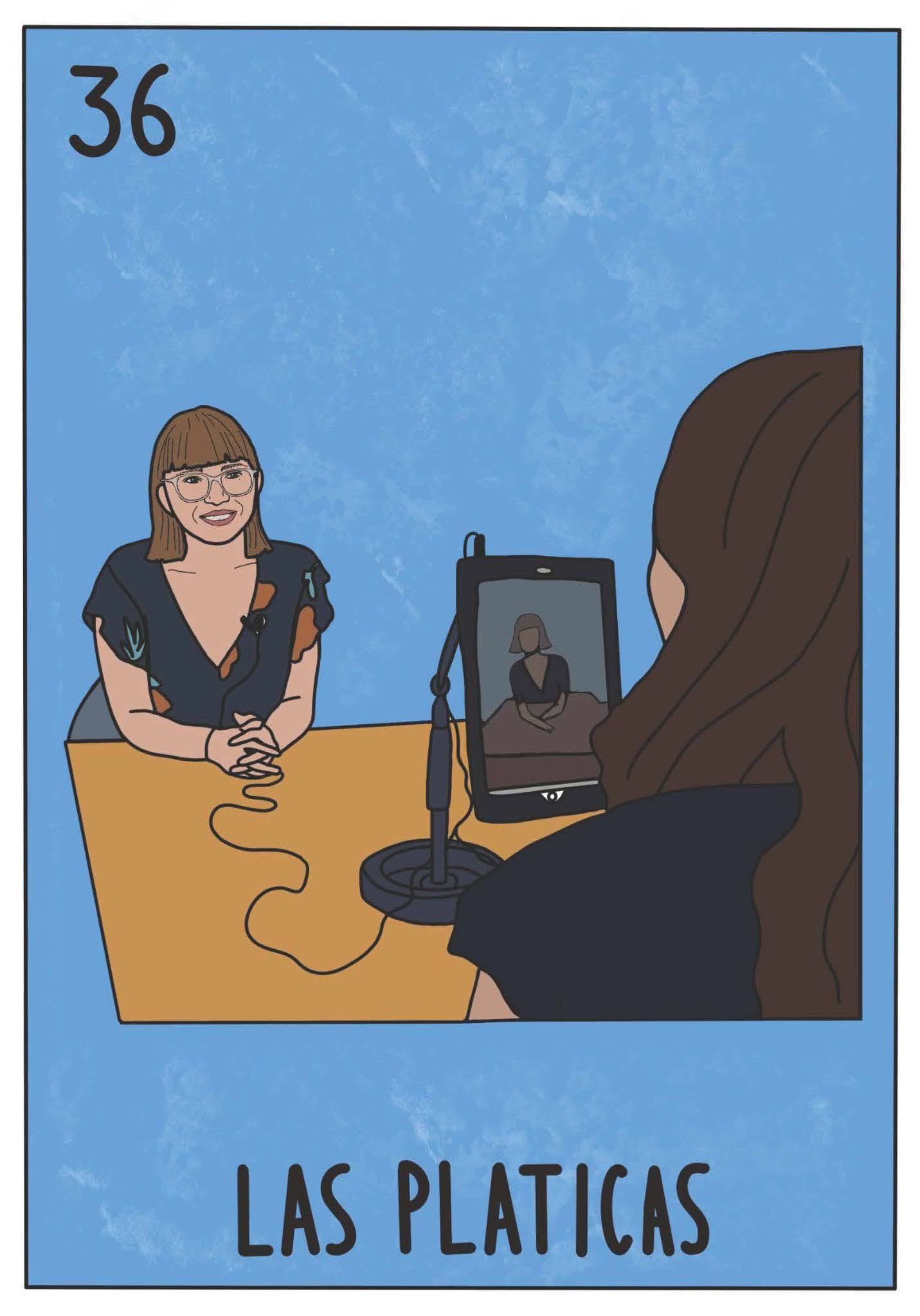
JT: Our collaboration began, tellingly, by accident. I can recall searching in the archive reading room for someone to pose with me for a reference photo to draw what it looks like when we use oral history equipment one day. I asked Caelin to sit across from me so I could pretend to interview her, but I ended up actually interviewing her because I found her answers interesting. What I noticed was how she listened. Her questions and her attention were sincere, joyful, guiding, and calming. I recognized in them the teaching qualities I had been trying to cultivate in Escuelita. Caelin had previously invited me to co-facilitate visits to Rising Youth Theatre, whose mission aligned with CDA’s and Escuelita’s. The partnership that joined Escuelita’s arts-based pedagogy to her teaching and theatre background has its origin in that reading room conversation.
“Las Pláticas” art by Vanessa Jasmine Torrez
CR: I wanted to seed this collaboration slowly, because I know how rare it is to find a partner whose approach to outreach is both genuinely flexible and intentional about youth, treating young people’s autonomy and capacity as leaders as a starting premise rather than an aspiration. I had also been sitting with the ethics of questions about privacy, consent, and what it means to document young people in the record. These issues had been weighing on me, and I did not want to bring youth into an archive without giving them real agency over how, and whether, their stories were kept. A community workshop that would let a group shape the session on its own terms felt like the honest way to address those concerns, and Rising Youth struck me from the start as a group that could be dialogic about the learning process.
What made the encounters possible was relational. The workshops were moments within a broader network of relationships, preceded by trust, reciprocity, and shared values. This necessitated the slower work of partnership-building, listening, and recognizing community expertise. In this case, the archive entered a relationship already grounded in mutual respect and shared understanding. This distinction makes clear that archival expertise does not reside solely within the archive.
The capacities that supported these workshops came as much from theatre practice, community work, and youth development as from archival training, which suggests that archives may have as much to learn from community cultural practice as community organizations have to learn from archives. Rather than asking how archives might preserve community memory after it has been created, we might ask how they can participate in ecosystems of memory-making already unfolding through art, performance, and storytelling. The young people at Rising Youth took up archival concepts less to master a body of knowledge than to imagine themselves as keepers of their own.
What belonging produces, in the end, is not only a young person’s sense of being welcome in the archive but also a change in the archive itself. When youth encounter the record as something they make and keep, rather than as something made about them or without them, their contributions enter the archive as authored acts of stewardship, not as materials collected on their behalf. The difference is consequential. An archive supplemented with marginalized materials after the fact remains part of an institution that decides whom to include, while an archive populated by creators who understand themselves as its authors and keepers is altered at its source. Instead of representation granted, this collaboration set in motion a future record whose shape is already being determined by those the archive has historically erased.
Conclusion
We wrestle against an imaginative idea of “the archive” that floats free of the endless impact of erasures, silences, the uncompensated labor, skimming the surface while the burdens of actual archives pull the archivist under (Berry, 2025). Our findings invite a reconsideration of what counts as archival expertise. Non-traditional pathways into archival work are often described through a language of absence. The relative marginality of non-traditional expertise may reveal more about the categories through which the profession understands itself than about practitioners. We therefore urge library leaders and LIS educators to treat archival labor undertaken by non-traditional participants as intellectual and ethical work rather than auxiliary service. They should invest in pedagogical training and mentorship for instructional archivists, treat youth engagement and affective practice as core competencies rather than electives, and integrate teaching, processing, and community engagement as mutually constitutive dimensions of archival responsibility rather than as ranked specializations. What is at stake is the profession’s capacity to function as archives should: as collections that reflect relational living practices that are accountable to the communities they claim to serve.
We ask more of practitioners and the institutions that employ them. We ask that they create and protect spaces built for emergent rather than delivered meaning. For youth, foster spaces that do not make participation contingent on adult-legible behavior. Engage with memory-making already underway in communities. Treat family, language, and play as conditions of the work, not disruptions.
Where a community is already keeping its own record through art, performance, or storytelling, the most useful institutional act is often to support that work, not absorb it. Third, they should treat the relational labor these encounters require through trust-building, listening, and showing up before there is a project. Fourth, they should know when to step back; when someone closer to a community is better positioned to do the work, the accountable act is to resource and uplift them rather than lead. This is skilled professional work that deserves training, time, and recognition.
We end where our epigraph began, with imagination. Like brown, we understand that who gets to imagine the future is a question of power, and we take our learners’ envisioning of themselves in the archive as the beginning of an answer. So we close by imagining forward. Archives are usually pictured as repositories, collections, and classrooms. What if they were also studios? An archival studio might not culminate in research papers or exhibits but in civic imagination: sites of rehearsal for possible futures, where students could use historical records not only to reconstruct a past but to prototype memory practices, where communities could design the archives they need, where young people could write the finding aids for their own collections. The question is no longer how we teach people about archives. It is how archives might join communities, and especially their youngest members, in imagining and sustaining collective futures. We manifest a profession where relational labor is valued, and where diverse pathways into archival work are read as expertise rather than deficit.
Acknowledgements
We thank our colleagues who laid the groundwork. Special recognition: Nancy Liliana Godoy, the director of the Community Driven Archives Initiative at Arizona State University Library.
Thank you to our editor, Ian Beilin, and our reviewers, Brittany Paloma Fiedler and Jennifer Douglas, for their support and guidance. We are also grateful to additional reviewers, Tammi Kim and Matthew Ogborn, for their assistance through this process.
We gratefully acknowledge the remarkable schools, organizations, educators, and students we have had the opportunity to collaborate with from Emerson Elementary School in Phoenix, Arizona, and Rising Youth Theater in Phoenix, Arizona. Their generosity, support, and knowledge allows Escuelita and youth-centered archive education to flourish.
References
Anzaldúa, G. (1999). Borderlands : La frontera (2nd ed.). Aunt Lute Books.
Batters, T. (2025). Outing Duoethnography as a Queer Methodology. International Journal of Qualitative Methods, 24. 16094069251370913.
Berry, D.J. (2025). The house archives built and other thoughts on black archival possibilities. We Here Press.
Bingham, C. W., & Sidorkin, A. M. Eds. (2004). No education without relation. Vol. 259. Peter Lang.
Cahnmann-Taylor, M., & Souto-Manning, M. (2010). Teachers act up! Creating multicultural learning communities through theatre. New York: Teachers College Press.
Chawla, D., & Atay, A. (2018). Introduction: Decolonizing autoethnography. Cultural Studies ↔ Critical Methodologies, 18(1), 3-8. https://doi.org/10.1177/1532708617728955
Dawson, K., et al. (2025). Drama for schools and beyond: Transformative learning through the arts. Intellect, Limited.
Douglas, J., Alisauskas, A., & Mordell, D. (2019). ‘Treat them with the reverence of archivists’: Records work, grief work, and relationship work in the archives. Archivaria 88 (November):84-120. https://archivaria.ca/index.php/archivaria/article/view/13699.
Eisner, E. W., & Yale University Press. (2002). The arts and the creation of mind. Yale University Press.
Elmborg, J. K. (2012). Critical information literacy: Definitions and challenges.” In Transforming information literacy programs: Intersecting frontiers of self, library culture, and campus community, edited by C. W. Wilkinson and C. Bruch, Chicago: Association of College and Research Libraries, 2012.
Ettorre, E. (2017). Autoethnography as feminist method: Sensitising the feminist ‘I’. Routledge.
Fierros, C. O., & Delgado Bernal, D. (2016). VAMOS A PLATICAR: The contours of pláticas as Chicana/Latina feminist methodology. Chicana/Latina Studies 15, no. 2: 98–121. http://www.jstor.org/stable/43941617.
Godoy, N.L. (2021). Community-driven archives: Conocimiento, healing and justice. Journal of Critical Library and Information Studies, vol.3, no.2https://doi.org/10.24242/jclis.v3i2.136
Greene, M. (1995). Releasing the imagination: Essays on education, the arts, and social change. Jossey-Bass Publishers.
Heathcote, D., Johnson, L., & O’Neill, C. (1991). Dorothy Heathcote: Collected writings on education and drama. Northwestern University Press.
Irwin, R. L., De Cosson, A., & Pinar, W. (2004). A/r/tography: Rendering self through arts-based living inquiry. Pacific Educational Press
Springgay, S., Irwin, R. L., & Kind, S. W. (2005). A/r/tography as living inquiry through art and text. Qualitative inquiry, 11(6), 897-912.
Skinner, M., & Hulbert, I. G. A*CENSUS II all archivists survey report. Ithaka S+R. Last Modified 22 August 2022. https://doi.org/10.18665/sr.317224.
Schlesselman-Tarango, G. (2019). Reproductive failure and information work: An autoethnography. Library Trends, 67(3), 436–454. https://doi.org/10.1353/lib.2019.0005
Sparrman, A., Hoyle, V. and Johanna Sjöberg (2024). Children as archive producers, participants, and agents: introduction to the special issue on children and archives. Archives and Records, 45(3), 207–218. https://doi.org/10.1080/23257962.2024.2415693
Stockton, K.B. (2009). The aueer child, or growing sideways in the twentieth century. Durham: Duke University Press.
Sullivan, G. (2004.) Art practice as research: Inquiry in the visual arts. Thousand Oaks, CA: Sage.
Sullivan, N. (2003). A critical introduction to queer theory. NYU Press.
Water, M. v. d. (2012). Theatre, youth, and culture: A critical and historical exploration. Palgrave Macmillan.